Industrial AI Pipeline: From Data to AI Recommendation
This is how isolated production data becomes reliable AI knowledge: OPAIRS structures, connects, and validates content in five steps for dependable decisions.
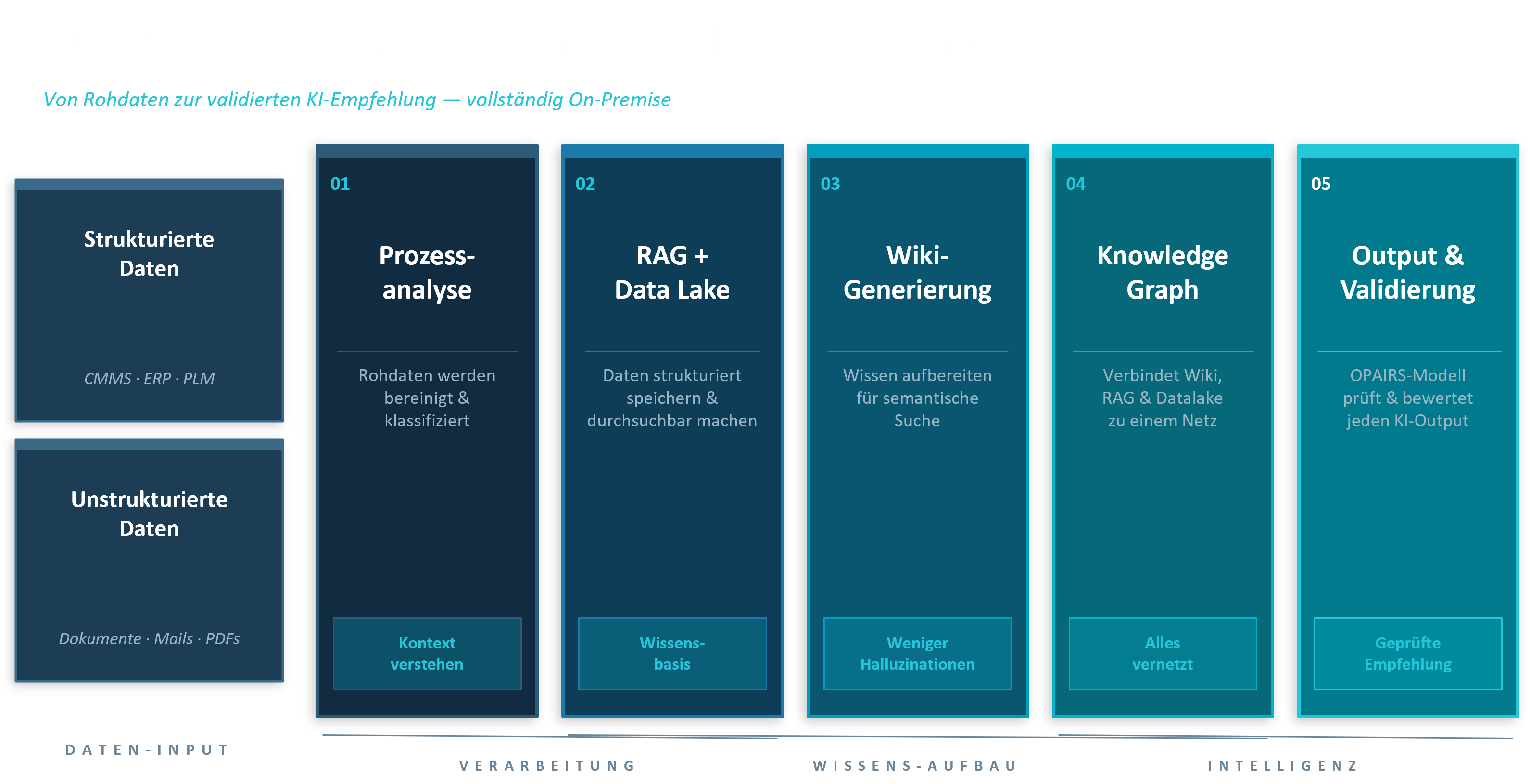
The most common problem with AI in production is not the technology but the data behind it. ERP systems, maintenance logs, PDFs from the network drive, images, and videos: all contain valuable knowledge. But as long as they remain isolated, no AI can work with them in a meaningful way. OPAIRS solves exactly that, in five stages, entirely local, without a single byte leaving the company.
The Starting Point: Two Data Worlds, One System
- Structured data: CMMS, ERP, PLM – clean, but isolated in systems that do not talk to each other.
- Unstructured data: Documents, emails, PDFs, maintenance reports, project plans, open-items lists – valuable knowledge that hardly anyone can find.
Stage 01 – Process Analysis: Understanding Context
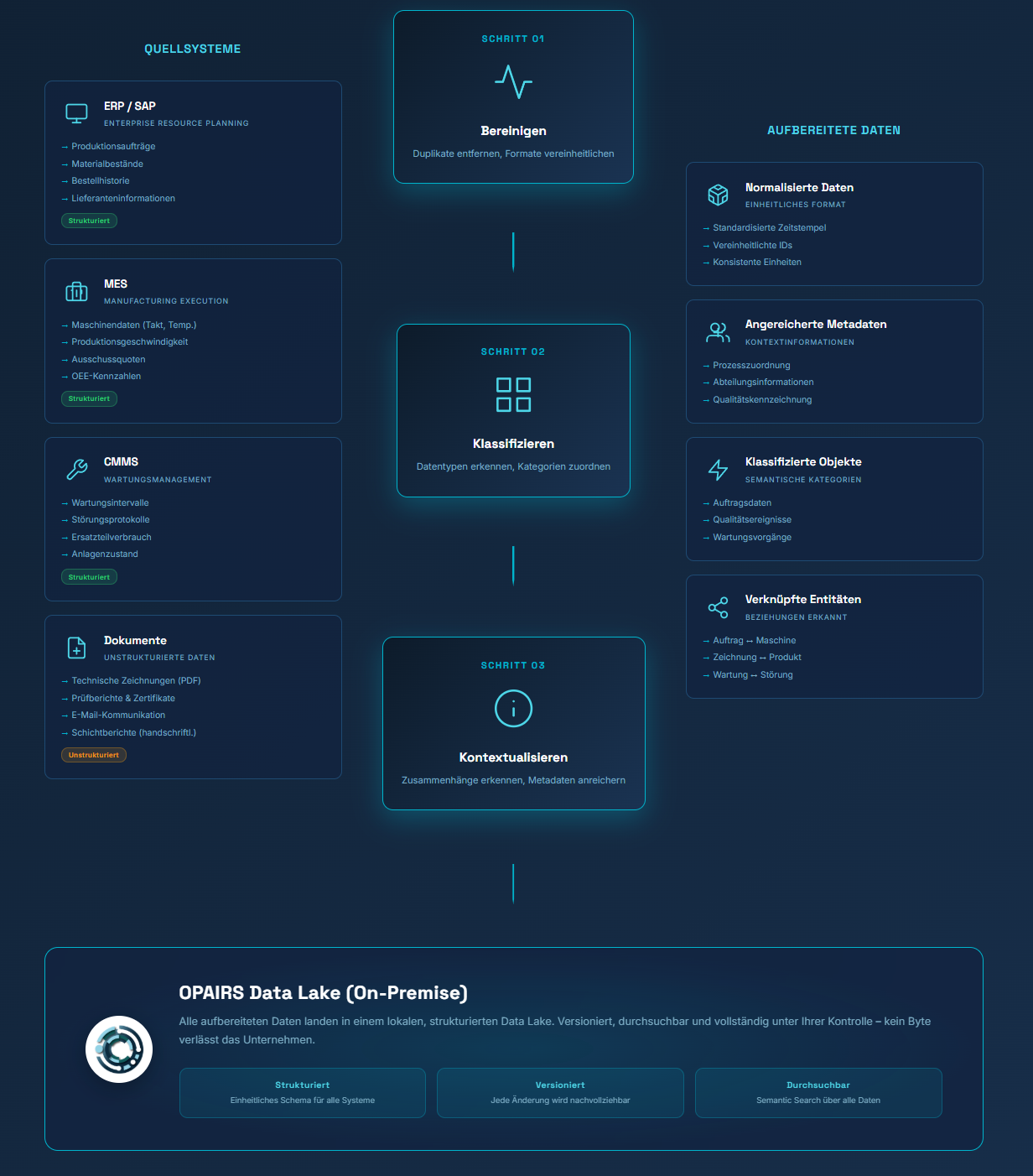
Before AI does anything, the data must be understood. OPAIRS automatically cleans, classifies, and organizes the raw data. The system learns what it has and what it means. Without this step, every AI solution will sooner or later produce nonsense.
Stage 02 – RAG + Data Lake: Building the Knowledge Base
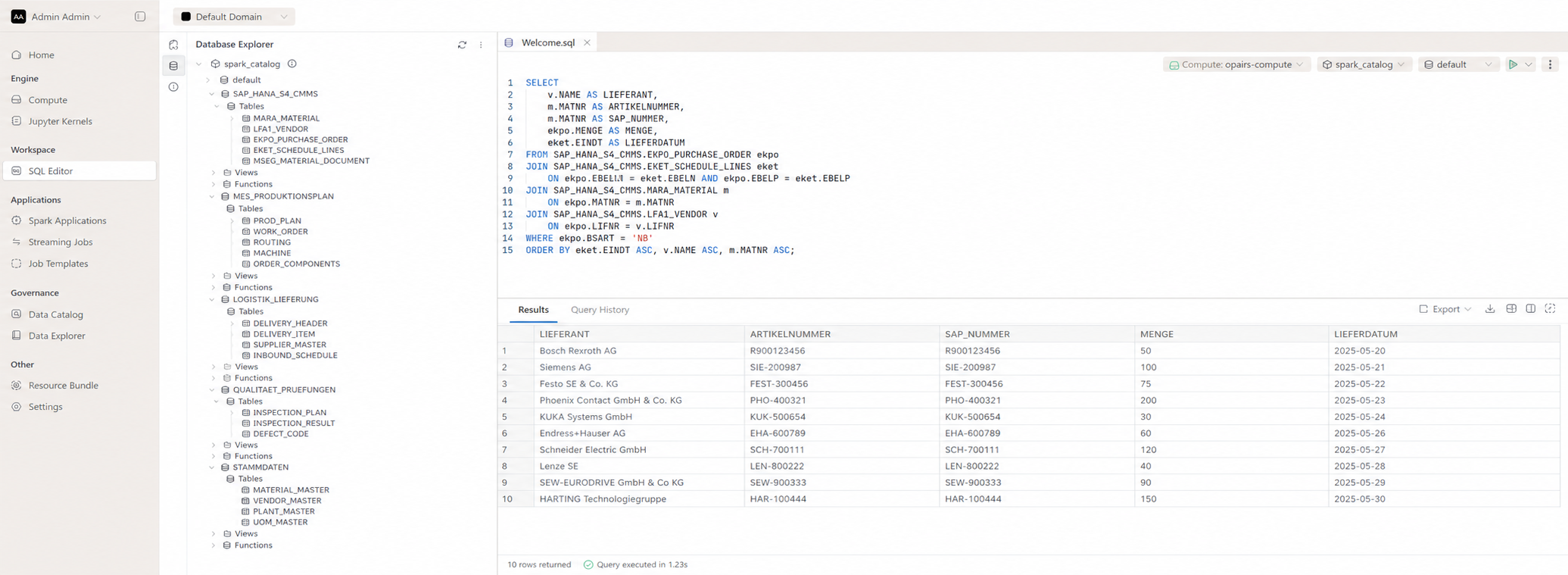
All data lands in a local data lake: structured, versioned, and searchable. Through RAG (Retrieval-Augmented Generation), the AI accesses relevant content that is unstructured or only semi-structured, instead of answering from memory.
Stage 03 – Wiki Generation: Fewer Hallucinations
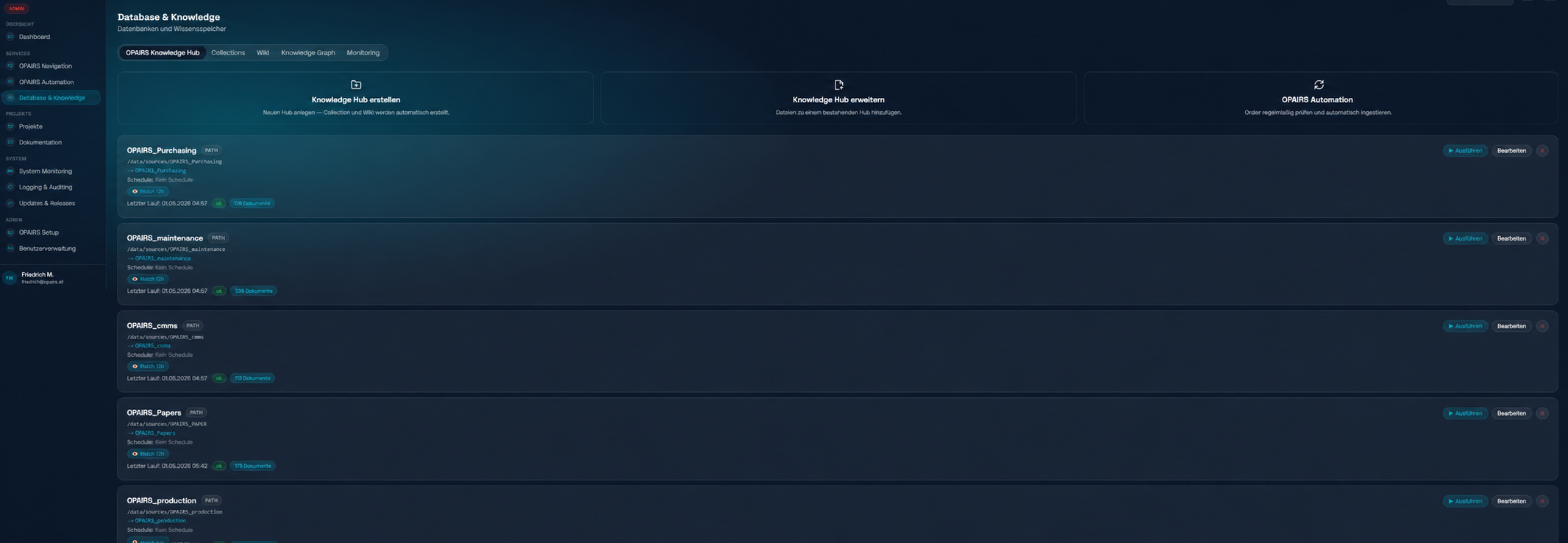
OPAIRS automatically builds structured knowledge pages from your own company data. The AI thus works with curated, verified knowledge instead of raw document fragments. This measurably improves semantic search and significantly reduces incorrect answers. At this point, data sources are already retrievable, but not yet connected end to end.
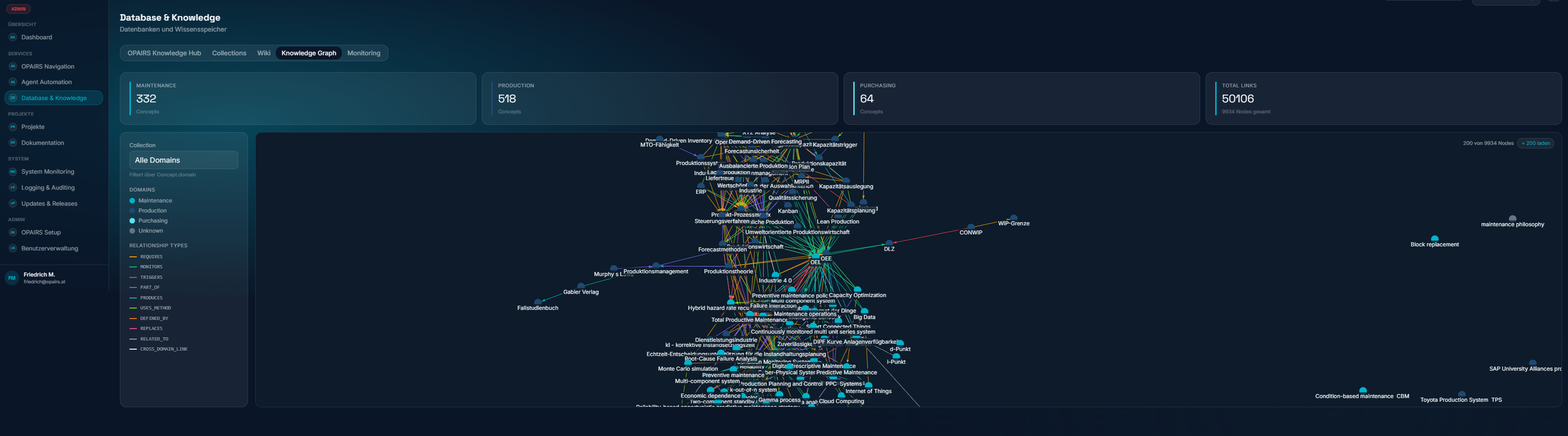
Stage 04 – Knowledge Graph: Everything Connected
Wiki, RAG, and data lake remain three silos as long as they are not connected. The OPAIRS knowledge graph maps the relationships between concepts, processes, and documents across domains. For example, maintenance, production, and purchasing speak the same language for the first time. Relationships and dependencies emerge, and the familiar corporate silos are broken down.
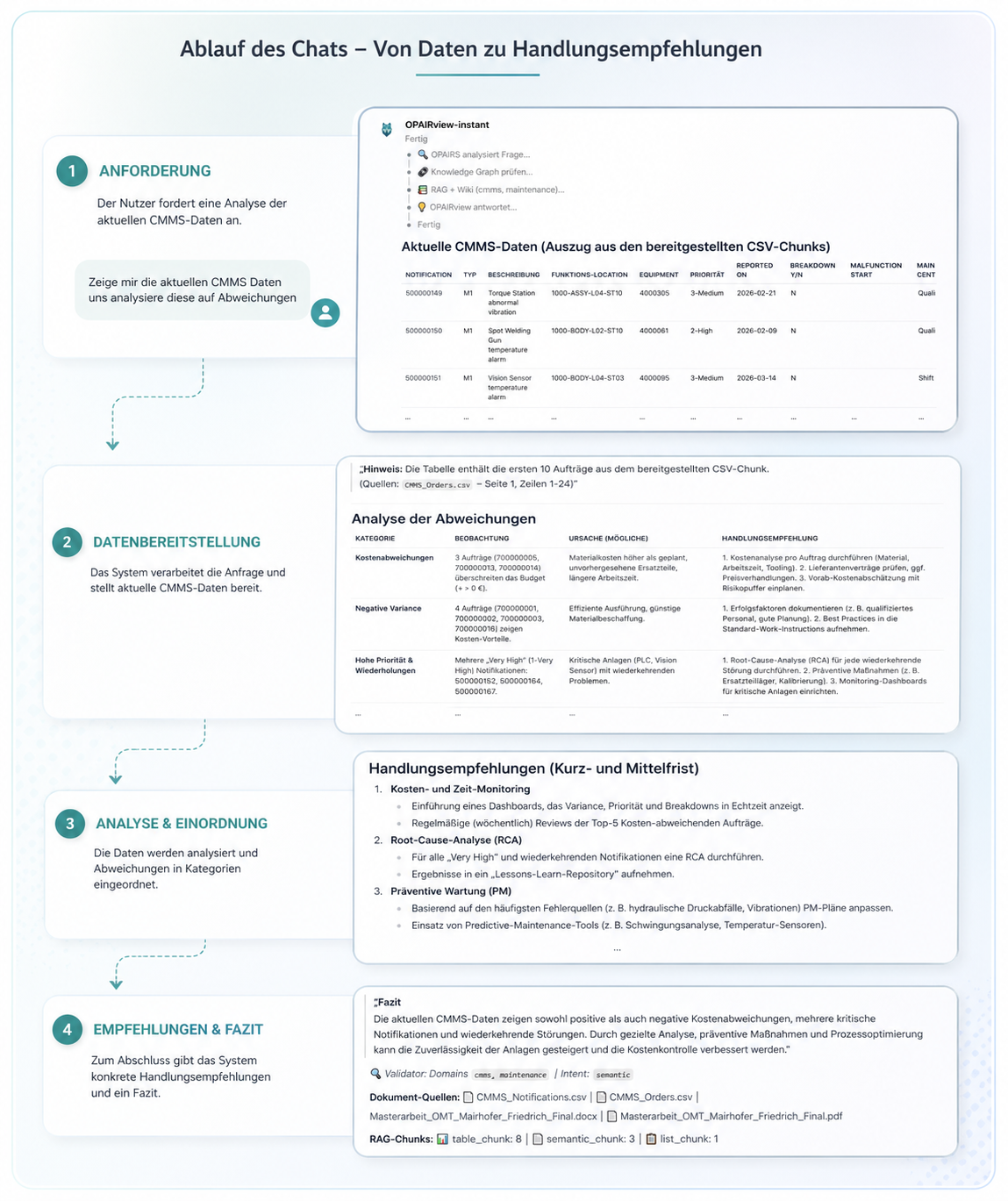
Stage 05 – Output & Validation: Verified Recommendation
At the end there is no raw AI answer, but a validated recommendation. A dedicated OPAIRS model checks every output before it reaches the user. That is the difference between "AI says something" and "AI says something reliable", and the point where industrial requirements and AI quality come together.
What This Means in Practice
- Imagine a meeting where the production information is already available, even under stress or when functions are missing.
- Maintenance teams see connections across production planning, logistics, and purchasing that were previously unclear.
- Managing directors receive decision foundations prepared in their own BI dashboard, as an app or web application. Focus projects are notified automatically.
All local. All under your control. No cloud provider, no ongoing API costs, no vendor lock-in. Procurable and depreciable like a production machine. OPAIRS is the deliberate alternative to generic AI platforms, built for manufacturing companies that take their knowledge seriously.
More insights
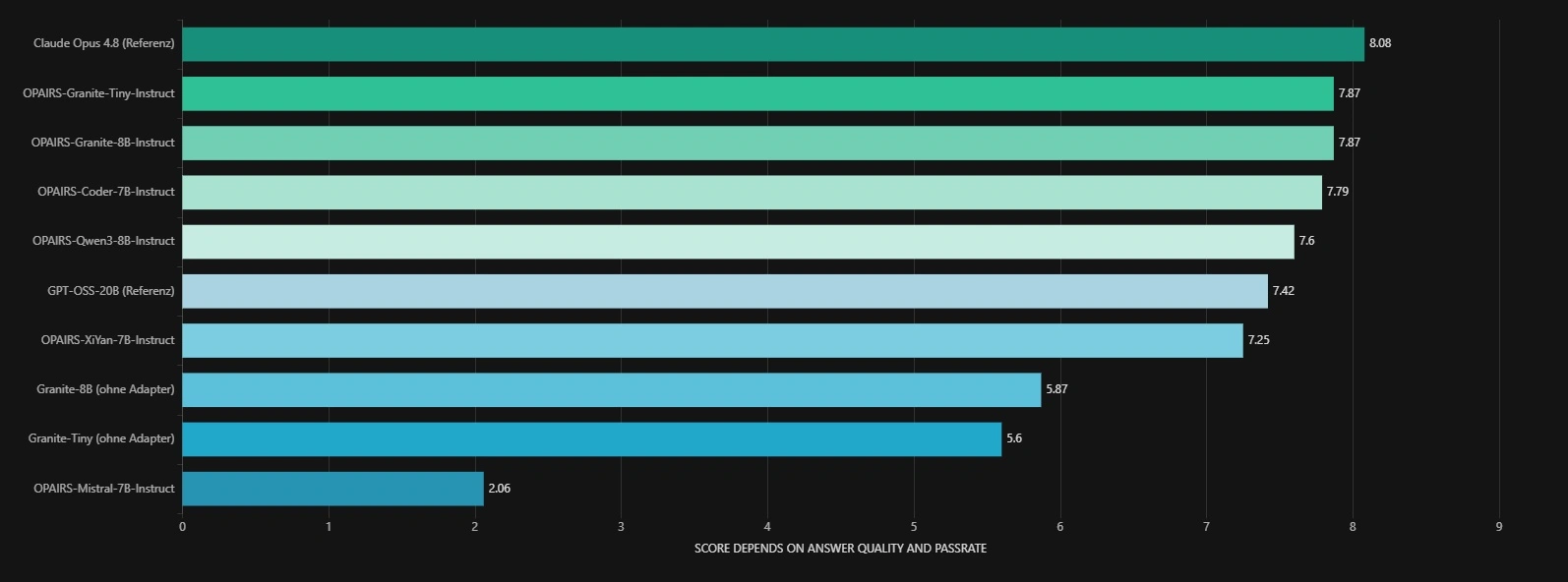
OPAIRS SQL Agent: Comparing Six LoRA Adapters for Industrial Databases
Six LoRA adapters, a 26-question catalog spanning PostgreSQL, T-SQL and Apache Iceberg databases, two external reference models: OPAIRS has systematically evaluated its SQL agent. Two Granite adapters lead the field. For production use, however, the deciding factors are not only answer quality but also speed, memory footprint, concurrency and the available context from ERP, MES, PLM and other industrial systems.
Read article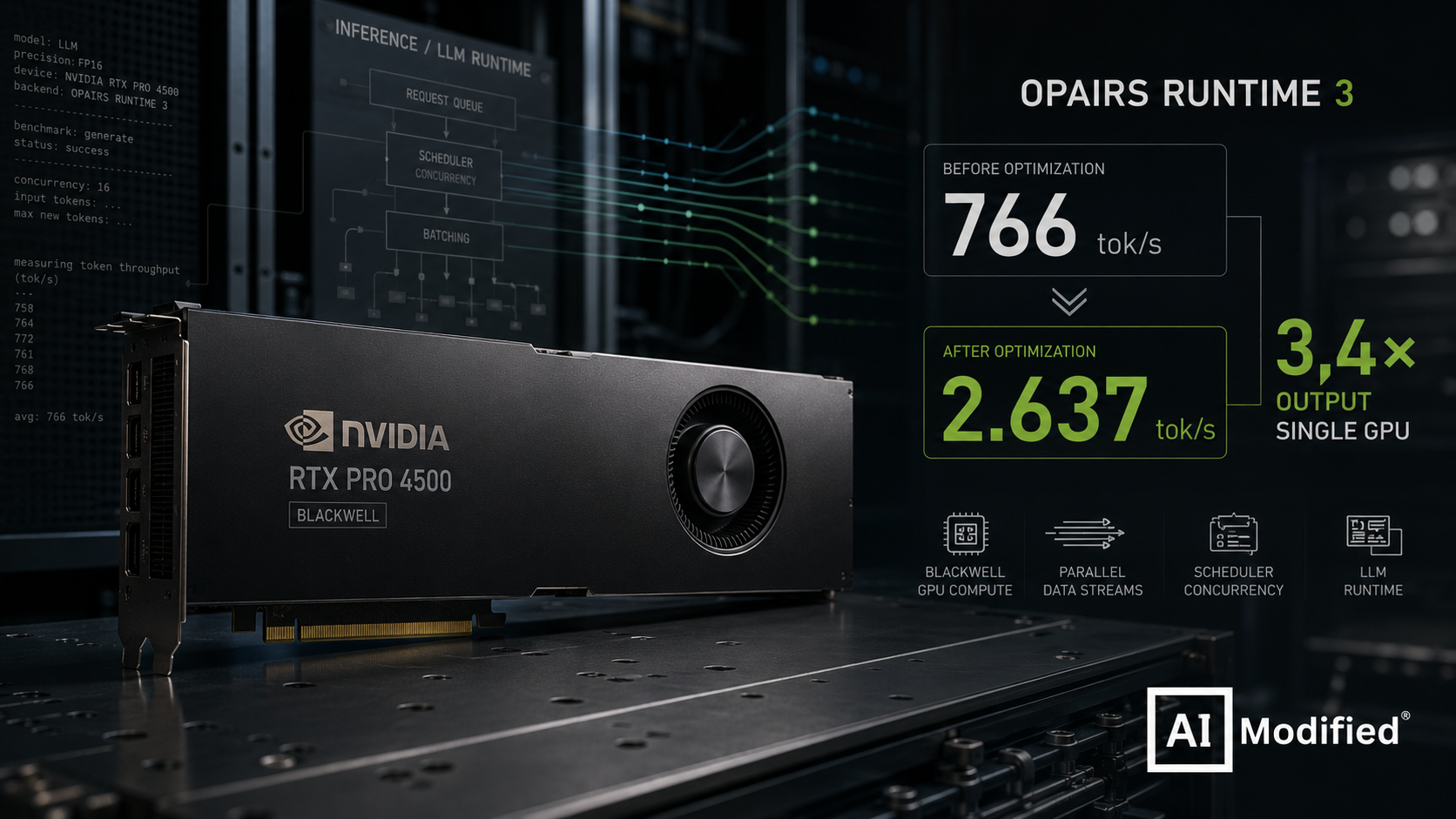
RTX PRO 4500 Blackwell: 3.4x LLM Throughput Through Runtime Optimization
Same GPU, same main model, up to 3.4x the output: OPAIRS Runtime 3 raises the throughput of GPT-OSS-20B on the RTX PRO 4500 Blackwell to up to 2,637 tokens/s. At the same time, the tests show why Qwen3.8-27B will not take over the production stack for now.
Read article